
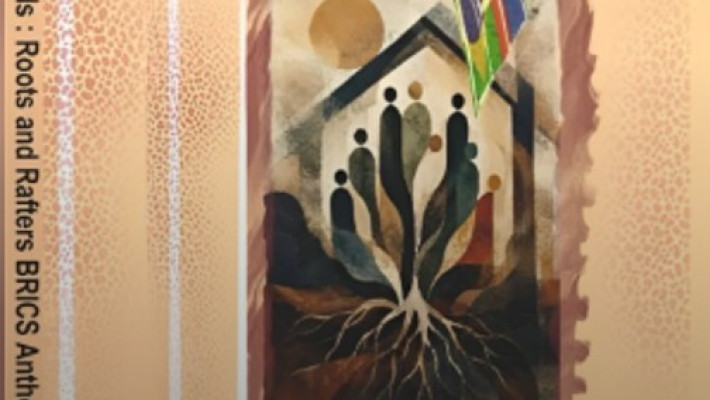
Antologia de Poesia dos BRICS - Together Upwards: Roots and Rafters
 Por Marcos Freitas Em: 12/11/2026, às 21H32
poesia mundial; poesia dos BRICS
Making Poetry the Common Language of Humankind
On the First BRICS Poetry Anthology
Dr Christine Chen (Chen Peiying) · Nov 7, 2026
Prelude: From the Amazon to the Ganges
Poetry is older than any frontier. Long before passports and tariffs, people sang beside their fires and recited verse on the banks of rivers. Today Brazil, Russia, India, China, and South Africa, together with Egypt, Ethiopia, Iran, the United Arab Emirates, Indonesia, and Saudi Arabia, and ten partner countries besides, form a family spanning four continents. When people speak of it, they speak mostly of trade and finance. This anthology has something else to say: beyond the figures and the clauses, there is the recognition of one heart by another.
In 2026 BRICS marked its twentieth year, and in that year the first BRICS poetry anthology came into being. Open it and you begin in the morning light of Brazil; you pass through the ancient basins of the Yellow River and the Nile, cross the snowfields of Russia, the thousand islands of Indonesia, and the streets of South Africa, and travel on to the highlands of Uganda, the rice fields of Vietnam, and the old Silk Road of Uzbekistan. Portuguese, Chinese, Arabic, Amharic, Persian, Russian, Indonesian, Vietnamese: poets from twenty-two countries and regions listen to one another within the covers of a single book.
I. The Lamps of Kolkata
In 2026 India assumed the rotating chairship of BRICS for the fourth time. That the anthology was born in this year makes it a fitting tribute.
And the hand that prepared the tribute was in Kolkata, the city of Tagore, where Asia's first Nobel laureate in literature wrote the songs he offered to the world. The ISISAR team in Kolkata has inherited the temper of that city. They sent invitations to more than twenty countries, corresponded with poets and translators, and gathered, arranged, and edited pages scattered across the globe until they became a book. Readers will not see this labour, yet it bears up every page. More admirably still, they did not look only to great nations and famous names: established poets and new voices, member states and partner countries, stand here side by side, as equals.
Kolkata's bond with poetry can be traced throughout the book. The Russian poet Vyacheslav Kupriyanov was published here in Bengali; the Vietnamese poet Huu Viet came here for a poetry festival.
The book is the work of four editors: two from India, Dr Sudipta and Nandita Samanta; Dr Christine Chen and the guest editor, Mr Vadim Terekhin, General Coordinator of the BRICS Writers' Association. Somdutta Chatterjee served as working editor, and the book owes much of its day-to-day labour to her care. Multiple mother tongues and traditions meeting in one book: this is itself a poem about collaboration. That Chinese was given an editor of its own shows how highly the BRICS family values Chinese-language poetry, and for this we are deeply grateful.
II. A Constellation in Chinese
The China section brings together a community of Chinese-language poets, represented by elders such as Jidi Majia and by poets of the diaspora such as Peiying (Christine Chen) and Xinyu (Victoria Xinyu Han). In 'The Responsibilities of a Poet', Jidi Majia writes that poetry is the soul's murmuring, yet must also bear the risks of upholding justice. The line might serve as an epigraph to the whole anthology.
Yet Chinese poetry no longer grows only on the soil of mainland China. There are more than sixty million overseas Chinese; count also those born abroad in the second and third generations, and descendants of mixed heritage who still cherish the language, and the community numbers some hundred million. They live, work, and dream in other people's lands, and they write in their mother tongue: poems of migration and of putting down roots, of the tension and reconciliation between two cultures. Such experience can no longer be represented by mainland poets alone. To let the Chinese of the diaspora speak in its own voice is the China section's most precious achievement.
Lan Xin is the only female inheritor of Dongba culture, at once a scholar and a practitioner of that ancient tradition. She stands on the land of her Naxi ancestors and carries the sacred mountains and the light of its pictographic script out into the world. She is a 'new indigene': rooted in ancient earth, her gaze turned towards all humanity. Her 'Light of Cosmic Peace' takes the sacred mountain of the Dongba scriptures as its image and declares that every kind thought illuminates the peace of the cosmos.
Xinyu (Victoria Xinyu Han), of Singapore, leads the Singapore International Chinese Poetry and Arts Festival. Her 'The Fortress' depicts the last moments of a mother crawling through the ruins towards her child: war has destroyed everything, but not a mother's love. It is the most breathtaking page in the book.
Dr Chen Peiying (Christine Chen), of New Zealand, is a 'transpacific poet' and one of the book's editors. She is Oceania President of the International Chamber of Writers and Artists (CIESART) and editor-in-chief of Global Muse. Her 'I live on the mountain' is as still as morning dew; and with a translator's pen she has carried into English the work of Zhang Jianjun, Shama Zhonghua (of the Yi people), Tan Yantong, and Wang Daobo, as well as Meng Ling's 'White Doves Singing for World Peace' from the Thailand section. She is a bridge, with Chinese at one end and readers across the Pacific at the other. Yuhang Liu, also of New Zealand, joins the chorus with 'Naive'.
Thailand's Meng Ling is a third-generation Thai Chinese, yet she has always written her poems in Chinese, and she serves as deputy editor of the literary supplement of China Daily News (Thailand). From Singapore to New Zealand, from Bangkok to Hong Kong, Chinese poetry has long been a net cast across the world.
III. Many Voices
The poems of Brazil are the book's first light. Ana Martins Marques's 'History' measures time by the 'age' of teeth and hair, of bread and a puddle, as lightly as a sigh; in a handful of lines, Salgado Maranhão's 'Kuarup' records the dwindling of an indigenous people from six million to fifteen hundred. Márcio Borges, a founder of the Clube da Esquina, and Marcos Freitas, co-chair of the BRICS Literature Network, let us hear the vein in Brazilian poetry that runs into music.
The Russia section is as vast as its snowfields. Its poets come from Murmansk, Karelia, Yakutia, Dagestan, and beyond, together almost a poetic map of the country, and Mr Terekhin is among them. Several Serbian poets travel with this section, and here the ancient songs of the Slavs flow together.
The Egypt section opens with Ahmad Al-Shahawy's 'Lover's Pilgrimage', and poets such as Tarek Eltayeb carry on the Arabic poetic tradition of the Nile. Here we pay particular tribute to Dr Sara Hamid Hawass, scholar at Mansoura University and herself a poet, who has for many years passed between Arabic and English. The English 'Lover's Pilgrimage' is hers; she rendered Al-Shahawy's poetry as Kiss of My Soul, brought twenty Pulitzer Prize-winning American poets to Arab readers, and saw The Keyhole Sees Nothing shortlisted for the Jabir Asfour Translation Prize. It is through such ferrywomen that Egyptian poetry crosses the river of language and reaches the shores of the world.
In the Iran section, Persian poetry flows from the classical masnavi to modern free verse; in the section for the United Arab Emirates and Saudi Arabia, Adel Khozam once planted The World Poetry Tree at Expo 2020 Dubai. In 'I Speak From Where I Stand', South Africa's Michael Gavin Koopman writes that peace is not negotiated in conference rooms but grows from everyday kindness in homes, classrooms, and streets. The Indonesia section is richly branched: Denny JA, pioneer of essay poetry, writes of a mother and son keeping vigil in the floods of Aceh, while Husnu Abadi, initiator of Indonesia Poetry Day, and many others make the archipelago's voices rise and answer one another. In 'Elegy in the Sand', translated from Amharic, Ethiopia's Bewketu Seyoum weeps quietly for woods that have given way to flagpoles.
IV. Small, Clear Voices
The generosity of an anthology is measured by how it treats small voices.
We pay special tribute to Uganda. In 'Seeds of Understanding', the poet and lawyer Awadifo Olga Kili writes that the drums of conflict beat loud in the marketplace of minds, while dialogue, like a stream wearing down rock, seeps into the parched earth of hearts until the seeds of understanding sprout. For years she has placed literature in the service of peacebuilding and post-conflict healing. This voice from the East African highlands is heard here, and heard with respect.
Nigeria's Ismail Bala, Omale Allen Abdul-Jabbar, and others bring the drumbeat of a new generation of African poets. In 'Poet', Nguyen Quang Thieu, Chairman of the Vietnam Writers' Association, turns the poet into a vast ear that hears every sound in the world; Huu Viet's 'The Key' is dedicated to the Palestinian people. Belarusian poets sing 'My Belarus'; poets from Bolivia, Cuba, Malaysia, Thailand, and Uzbekistan join the chorus in the timbres of their mother tongues; and Kazakhstan's Bakhyt Rustemov reaches across half the globe to write an ode to the Māori ancestors and the ocean of Aotearoa New Zealand. The Palestinian poet Abdulla Issa grew up in a refugee camp; his poems are the heaviest stone in the book.
Here, whatever the size of the nation or the reach of the language, every poet is given an equally dignified page.
V. Gathered for Peace
That the anthology should meet its readers at a peace writers' conference is a choice made with great care.
Peace is the longest thread running through the book. In 'Orgy of Bombs', Kori Bolivia writes of children whose souls spill out among the stones that were once their home; Xinyu writes of a mother's love as a fortress in the ruins; Lan Xin prays for the world by the light of the sacred mountain; Kili shows how dialogue can outlast the drums of conflict; and Koopman reminds us that peace must first live in ourselves.
Poets have no armies and no budgets; they have only language. Yet language is the first step by which one person reaches another. To set this book upon the platform of peace is to return poetry to its oldest calling: to let us see one another.
Coda
A first anthology always carries something of the world's beginning. May this one not remain a solitary volume but become the source of a river, so that, year after year, voices from great nations and small, from the centre and the margins, may follow its course and meet within the pages of a single book.
Our thanks to India, to our friends in Kolkata, to the editors, and to every poet and translator.
References
- ISISAR Kolkata (comp.), BRICS Anthology Submission Poems (manuscript, February 2026). Source of all poems, translations, and biographical details cited above.
- 'India prepares to host BRICS Summit', SAnews (South African Government News Agency), 2026, https://www.sanews.gov.za/node/84180. On the eleven member states and India's fourth chairship, assumed on 1 January 2026.
- Business Today Desk, 'BRICS decoded: the origin, evolution, members, partners and future of the summit', Business Today, 10 September 2026, https://www.businesstoday.in/india/story/bt-explainerbrics-decoded-the-origin-evolution-members-partners-and-future-of-the-summit-554110-2026-09-10. On the ten partner countries and the twentieth anniversary of BRICS.
- Li Minghuan, '“Da qiaowu” guannian wei Zhongguo qiaowu gongzuo tigong zunxun' [The 'greater overseas Chinese affairs' concept as a guide for China's work with overseas Chinese], Renmin Ribao Haiwai Ban [People's Daily Overseas Edition], 26 September 2025, p. 6, https://paper.people.com.cn/rmrbhwb/pc/content/202509/26/content_30107237.html. On the figure of more than sixty million overseas Chinese.
- 'The Nobel Prize in Literature 1913: Rabindranath Tagore', NobelPrize.org, https://www.nobelprize.org/prizes/literature/1913/summary/.
Note. The figure of some hundred million is a broad estimate that includes later generations and descendants of mixed heritage; it is not drawn from an official census.
Fazendo da Poesia a Linguagem Comum da Humanidade
Sobre a Primeira Antologia de Poesia dos BRICS
Dra. Christine Chen (Chen Peiying) · 7 de novembro de 2026
Prelúdio: Da Amazônia ao Ganges
A poesia é mais antiga que qualquer fronteira. Muito antes de passaportes e tarifas alfandegárias, as pessoas cantavam ao redor de suas fogueiras e recitavam versos às margens dos rios. Hoje, Brasil, Rússia, Índia, China e África do Sul, juntamente com Egito, Etiópia, Irã, Emirados Árabes Unidos, Indonésia e Arábia Saudita, além de dez países parceiros, formam uma família que abrange quatro continentes. Quando se fala disso, fala-se principalmente de comércio e finanças. Esta antologia tem algo mais a dizer: além dos números e das cláusulas, há o reconhecimento de um coração por outro.
Em 2026, os BRICS completaram vinte anos, e nesse ano surgiu a primeira antologia de poesia dos BRICS. Ao abri-la, você se depara com a luz da manhã no Brasil; atravessa as antigas bacias do Rio Amarelo e do Nilo, cruza os campos de neve da Rússia, as mil ilhas da Indonésia e as ruas da África do Sul, e segue para os planaltos de Uganda, os arrozais do Vietnã e a antiga Rota da Seda do Uzbequistão. Português, chinês, árabe, amárico, persa, russo, indonésio, vietnamita: poetas de vinte e dois países e regiões se ouvem mutuamente dentro das páginas de um único livro.
I. As Lâmpadas de Calcutá
Em 2026, a Índia assumiu a presidência rotativa dos BRICS pela quarta vez. O fato de a antologia ter nascido neste ano torna-a uma homenagem apropriada.
E a mão que preparou essa homenagem estava em Calcutá, a cidade de Tagore, onde o primeiro laureado asiático com o Prêmio Nobel de Literatura escreveu as canções que ofereceu ao mundo. A equipe do ISISAR em Calcutá herdou o espírito daquela cidade. Enviaram convites a mais de vinte países, trocaram correspondências com poetas e tradutores e reuniram, organizaram e editaram páginas espalhadas pelo mundo até que se tornassem um livro. Os leitores não verão esse trabalho, mas ele se reflete em cada página. Mais admirável ainda é o fato de não terem se limitado a grandes nações e nomes famosos: poetas consagrados e novas vozes, estados-membros e países parceiros, estão aqui lado a lado, em igualdade de condições.
A ligação de Calcutá com a poesia transparece ao longo de todo o livro. O poeta russo Vyacheslav Kupriyanov teve seus trabalhos publicados aqui em bengali; o poeta vietnamita Huu Viet esteve na cidade para um festival de poesia.
O livro é fruto do trabalho de quatro editores: dois da Índia, Dr. Sudipta e Nandita Samanta; Dra. Christine Chen e o editor convidado, Sr. Vadim Terekhin, Coordenador Geral da Associação de Escritores dos BRICS. Somdotta Chatterjee atuou como editora de trabalho, e muito do trabalho diário do livro se deve ao seu cuidado. Múltiplas línguas maternas e tradições se encontram em um único livro: este é, em si, um poema sobre colaboração. O fato de o chinês ter recebido um editor próprio demonstra o quanto a família BRICS valoriza a poesia em língua chinesa, e por isso somos profundamente gratos.
II. Uma Constelação em Chinês
A seção dedicada à China reúne uma comunidade de poetas de língua chinesa, representada por veteranos como Jidi Majia e por poetas da diáspora como Peiying (Christine Chen) e Xinyu (Victoria Xinyu Han). Em "As Responsabilidades de um Poeta", Jidi Majia escreve que a poesia é o murmúrio da alma, mas também deve arcar com os riscos de defender a justiça. Essa frase poderia servir como epígrafe para toda a antologia.
No entanto, a poesia chinesa não floresce mais apenas no solo da China continental. Há mais de sessenta milhões de chineses no exterior; contando também aqueles nascidos fora do país, na segunda e terceira gerações, e os descendentes de ascendência mista que ainda valorizam a língua, e a comunidade chega a cerca de cem milhões. Eles vivem, trabalham e sonham em terras alheias e escrevem em sua língua materna: poemas sobre migração e enraizamento, sobre a tensão e a reconciliação entre duas culturas. Tal experiência não pode mais ser representada apenas por poetas da China continental. Permitir que os chineses da diáspora falem com a sua própria voz é a conquista mais preciosa da seção sobre a China.
Lan Xin é a única herdeira feminina da cultura Dongba, sendo ao mesmo tempo erudita e praticante dessa antiga tradição. Ela se ergue sobre a terra de seus ancestrais Naxi e leva consigo as montanhas sagradas e a luz de sua escrita pictográfica para o mundo. Ela é uma "nova indígena": enraizada na terra ancestral, seu olhar se volta para toda a humanidade. Sua obra "Luz da Paz Cósmica" toma a montanha sagrada das escrituras Dongba como imagem e declara que todo pensamento bondoso ilumina a paz do cosmos.
Xinyu (Victoria Xinyu Han), de Singapura, dirige o Festival Internacional de Poesia e Artes Chinesas de Singapura. Sua obra "A Fortaleza" retrata os últimos momentos de uma mãe rastejando pelas ruínas em direção ao seu filho: a guerra destruiu tudo, menos o amor de uma mãe. É a página mais comovente do livro.
A Dra. Chen Peiying (Christine Chen), da Nova Zelândia, é uma "poeta transpacífica" e uma das editoras do livro. Ela é presidente da Oceania da Câmara Internacional de Escritores e Artistas (CIESART) e editora-chefe da Global Muse. Seu poema "Eu vivo na montanha" é tão sereno quanto o orvalho da manhã; e com a pena de uma tradutora, ela levou para o inglês as obras de Zhang Jianjun, Shama Zhonghua (do povo Yi), Tan Yantong e Wang Daobo, bem como "Pombas Brancas Cantando pela Paz Mundial", de Meng Ling, da seção dedicada à Tailândia. Ela é uma ponte, com o chinês em uma extremidade e os leitores do outro lado do Pacífico na outra. Yuhang Liu, também da Nova Zelândia, junta-se ao coro com o poema "Ingênua".
Meng Ling, da Tailândia, é uma tailandesa de ascendência chinesa de terceira geração, mas sempre escreveu seus poemas em chinês e atua como editora adjunta do suplemento literário do China Daily News (Tailândia). De Singapura à Nova Zelândia, de Bangkok a Hong Kong, a poesia chinesa há muito tempo é uma rede lançada ao redor do mundo.
III. Muitas Vozes
Os poemas do Brasil são a primeira luz do livro. "História", de Ana Martins Marques, mede o tempo pela "idade" dos dentes e dos cabelos, do pão e de uma poça, com a leveza de um suspiro; em poucos versos, "Kuarup", de Salgado Maranhão, registra o declínio de um povo indígena de seis milhões para mil e quinhentos. Márcio Borges, fundador do Clube da Esquina, e Marcos Freitas, co-presidente da Rede de Literatura dos BRICS, nos permitem ouvir a veia da poesia brasileira que se encontra com a música.
A seção sobre a Rússia é tão vasta quanto seus campos de neve. Seus poetas vêm de Murmansk, Carélia, Iacútia, Daguestão e além, formando juntos quase um mapa poético do país, e o Sr. Terekhin está entre eles. Vários poetas sérvios acompanham esta seção, e aqui as antigas canções dos eslavos se misturam.
A seção do Egito começa com 'A Peregrinação do Amante', de Ahmad Al-Shahawy, e poetas como Tarek Eltayeb dão continuidade à tradição poética árabe do Nilo. Prestamos aqui uma homenagem especial à Dra. Sara Hamid Hawass, estudiosa da Universidade de Mansoura e ela mesma poeta, que durante muitos anos transitou entre o árabe e o inglês. A 'Peregrinação do Amante' em inglês é dela; ela interpretou a poesia de Al-Shahawy como Beijo da Minha Alma, trouxe vinte poetas americanos vencedores do Prêmio Pulitzer para leitores árabes e viu O Olho da Chave Não Vê Nada ser selecionado para o Prêmio de Tradução Jabir Asfour. É por meio dessas barqueiras que a poesia egípcia atravessa o rio da linguagem e alcança as margens do mundo.
Na seção dedicada ao Irã, a poesia persa flui do clássico masnavi ao verso livre moderno; na seção dos Emirados Árabes Unidos e da Arábia Saudita, Adel Khozam plantou a Árvore Mundial da Poesia na Expo 2020 Dubai. Em "Eu Falo de Onde Estou", o sul-africano Michael Gavin Koopman escreve que a paz não é negociada em salas de conferência, mas nasce da gentileza cotidiana em lares, salas de aula e ruas. A seção sobre a Indonésia é ricamente ramificada: Denny JA, pioneiro da poesia-ensaio, escreve sobre uma mãe e um filho que mantêm vigília nas enchentes de Aceh, enquanto Husnu Abadi, idealizador do Dia da Poesia da Indonésia, e muitos outros fazem com que as vozes do arquipélago se elevem e respondam umas às outras. Em "Elegia na Areia", traduzido do amárico, o etíope Bewketu Seyoum chora silenciosamente pelas florestas que deram lugar a mastros de bandeiras.
IV. Vozes Minoritárias e Claras
A generosidade de uma antologia se mede pela forma como ela trata as vozes minoritárias.
Prestamos uma homenagem especial a Uganda. Em "Sementes da Compreensão", a poeta e advogada Awadifo Olga Kili escreve que os tambores do conflito ressoam alto no mercado das mentes, enquanto o diálogo, como um riacho que desgasta a rocha, penetra na terra árida dos corações até que as sementes da compreensão germinem. Há anos, ela coloca a literatura a serviço da construção da paz e da cura pós-conflito. Esta voz das terras altas da África Oriental é ouvida aqui, e ouvida com respeito.
Ismail Bala, da Nigéria, Omale Allen Abdul-Jabbar e outros trazem o ritmo pulsante de uma nova geração de poetas africanos. Em "Poeta", Nguyen Quang Thieu, presidente da Associação de Escritores do Vietnã, transforma o poeta em um ouvido vasto que escuta todos os sons do mundo; "A Chave", de Huu Viet, é dedicada ao povo palestino. Poetas bielorrussos cantam "Minha Bielorrússia"; poetas da Bolívia, Cuba, Malásia, Tailândia e Uzbequistão unem-se ao coro nos timbres de suas línguas maternas; e Bakhyt Rustemov, do Cazaquistão, alcança metade do globo para escrever uma ode aos ancestrais maori e ao oceano de Aotearoa Nova Zelândia. O poeta palestino Abdulla Issa cresceu em um campo de refugiados; seus poemas são a pedra mais pesada do livro.
Aqui, independentemente do tamanho da nação ou do alcance do idioma, cada poeta recebe uma página igualmente digna.
V. Reunidos pela Paz
O fato de a antologia ter sido lançada em uma conferência de escritores sobre a paz foi uma escolha feita com muito cuidado.
A paz é o fio condutor que permeia todo o livro. Em "Orgia de Bombas", Kori Bolivia escreve sobre crianças cujas almas se espalham entre as pedras que um dia foram seu lar; Xinyu escreve sobre o amor de uma mãe como uma fortaleza em meio às ruínas; Lan Xin ora pelo mundo à luz da montanha sagrada; Kili mostra como o diálogo pode sobreviver aos tambores do conflito; e Koopman nos lembra que a paz deve primeiro habitar em nós mesmos.
Poetas não têm exércitos nem orçamentos; eles têm apenas a linguagem. No entanto, a linguagem é o primeiro passo pelo qual uma pessoa alcança a outra. Fundamentar este livro na plataforma da paz é devolver à poesia sua vocação mais antiga: permitir que nos vejamos uns aos outros.
Coda
Uma primeira antologia sempre carrega consigo algo do começo do mundo. Que esta não permaneça um volume solitário, mas se torne a nascente de um rio, para que, ano após ano, vozes de grandes e pequenas nações, do centro e das margens, possam seguir seu curso e se encontrar nas páginas de um único livro.
Nossos agradecimentos à Índia, aos nossos amigos em Calcutá, aos editores e a todos os poetas e tradutores.
Referências
- ISISAR Kolkata (comp.), BRICS Anthology Submission Poems (manuscrito, fevereiro de 2026). Fonte de todos os poemas, traduções e detalhes biográficos citados acima.
- 'Índia se prepara para sediar a Cúpula dos BRICS', SAnews (Agência de Notícias do Governo Sul-Africano), 2026, https://www.sanews.gov.za/node/84180. Sobre os onze estados membros e a quarta presidência da Índia, assumida em 1º de janeiro de 2026.
- Business Today Desk, 'BRICS decodificados: a origem, evolução, membros, parceiros e futuro da cúpula', Business Today, 10 de setembro de 2026, https://www.businesstoday.in/india/story/bt-explainerbrics-decoded-the-origin-evolution-members-partners-and-future-of-the-summit-554110-2026-09-10. Sobre os dez países parceiros e o vigésimo aniversário do BRICS.
- Li Minghuan, '"Da qiaowu" guannian wei Zhongguo qiaowu gongzuo tigong zunxun' [O conceito de 'grandes assuntos chineses ultramarinos' como guia para o trabalho da China com chineses no exterior], Renmin Ribao Haiwai Ban [Edição People's Daily Overseas], 26 de setembro de 2025, p. 6, https://paper.people.com.cn/rmrbhwb/pc/content/202509/26/content_30107237.html. Sobre o número de mais de sessenta milhões de chineses no exterior.
- 'O Prêmio Nobel de Literatura 1913: Rabindranath Tagore', NobelPrize.org, https://www.nobelprize.org/prizes/literature/1913/summary/.
Nota. O número de cerca de cem milhões é uma estimativa ampla que inclui gerações posteriores e descendentes de herança mista; não é extraído de um censo oficial.
[tradução do inglês ao português por Marcos Freitas]
words
to Cecilia Meireles
words fly
at each road step
on each floor
on each nothing
words
like ants lined up
words like hungry eagles
flanking - almost weightless –
up in the air
words squeaking the song of the cosmos
infinite-abyss
in every vacuum
in all nothing
our dream
some say dreams should be lived;
others that they should be shared;
one might say dreams are just dreams.
and what do i say?
and what do i dream?
sometimes the past
looks like future to me ...
present or past –
but who knows!
what to expect from a dream?
what to expect from whom you are?
sounds and dreams –
timeless musical scores.
Poems from Marcos Freitas, translated by the author.
Marcos Freitas (b. 1963, Teresina, Piauí) is a Brazilian poet, lyricist and composer. He is a civil engineer and university professor. He has published over a hundred technical and scientific articles in Brazilian and international journals and symposium proceedings, as well as over 70 technical and literary books. Member of UBC, ANE, UBE-SP, Sindescritores, president of the Academia de Letras do Brasil (ALB) and co-chair of the BRICS Literature Network.